What is 'alternative' about alternative social media?
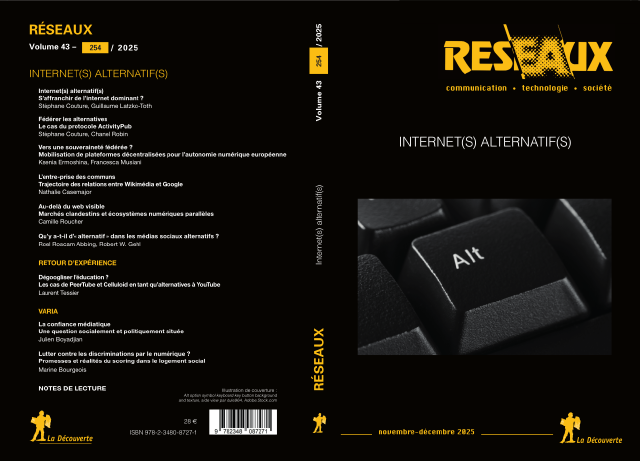
As part of the special issue on Alternative Internets in journal Réseaux, Rob W. Gehl and me have an article called What is ‘alternative’ about alternative social media?.
In the piece we look back on the last 15 years of alternative social media (ASM) research to reflect on how scholars have differently understood ASM. Early beginnings focused on ASM as something based on F/LOSS, decentralisation and anti-commerical politics. Later came understandings of ASM as “alt-right” social media, leading to the more contemporary focus on issues of governance. Throughout the piece we complicate such understandings to eventually propose a working definition which sees ASM as relational, emergent, and dynamic. In addition, we argue ASM scholars must use a situated perspective when studying ASM.
This paper is probably useful for those that:
-
Are unfamiliar with ASM studies and look for an overview of the field. The paper references many works across disciplines that touch on ASM. We build on the Network of Alternative Social Media Researchers bibliography
-
Are looking for ways to understand how to engage with the “alternative” in ASM and how others have done so.
-
Are looking for a working definition as a point of departure. We realize its not perfect, but therefore we stress its a working definition.
Résaux is a Francophone journal so the published article is translated to French: https://doi.org/10.3917/res.254.0183.
Our English accepted version can also be found here: https://shs.cairn.info/journal-reseaux-2025-6-page-183?lang=en (mirror). I’m very happy to have the article available in two major languages.
Abstract
Page(/log/2026-what-is-alternative-about-asm)What are alternative social media (ASM)? What is it that makes social media ‘alternative’ and how can one approach their study? Rather than attempting to answer these questions in order to provide a precise and stable definition of alternative social media, this paper will offer a working definition of ASM. Building on an archive of alternative social media scholarship (n=127), we problematize ‘alternative’ as an analytical category and how it has been configured thus far. Based on this work, we conclude that ASM scholarship should analyse ASM as relational, emergent, and dynamic. In addition, we argue ASM scholars must use a situated perspective. In doing so, scholars working in the field will be able to ask sharper questions both about ASM as well as mainstream social media.