How federated systems dissapear
This post briefly explores one small but significant obstacle to a broader adoption of the fediverse: there is no fediverse!
Of course there is one, but due to the federated nature of the fediverse, it completely disappears from aggregate visitor and referral statistics in web logs. This might seem like either a trivial observation or, even, in the views of some, a positive outcome, but it also means that in the eyes of some decision makers, it just does not exist or is irrelevant. Invisibility in web traffic statistics is one of the barriers to adoption and a barrier to convincing others of the merit of investing resources in the fediverse. You cannot adopt what does not seem to exist.
The problem is, in its essence, one of decentralization. As of writing, there are 42,328 different fediverse instances1, which are hosted under different (sub)domains. That means that anyone who is interested to know whether posting an article to the fediverse is worth the effort and uses web traffic statistics to find out will always get a clear and simple answer: no, it is not worth the effort.
Why is that? Because 42,328 domain names will always end up in the long tail of “other” in web traffic statistics, whether they bring actual traffic or not. That is, the fediverse as a whole will always rank below sources such as “twitter.com”, “bsky.app”, “x.com”, “google.com”, “facebook.com”, “news.ycombinator.com”, which are all services with single or limited numbers of domain names. Even if posting an article to the fediverse leads to that article being shared widely and creating a surge in traffic to the original source, that original source will never know.
In a federated system, that effect gets diffused into the long tail of web traffic, whereas in a centralized system it becomes visible. Why should any publisher invest in that weird Mastodon system if it clearly does not bring traffic, whereas facebook.com does?
So, does the fediverse exist?
I happen to have access to some of the traffic statistics of solar.lowtechmagazine.com. I know this website is shared on the fediverse now and then, so it makes a good case to test my theory that the fediverse is invisibilized by its own decentralisation.
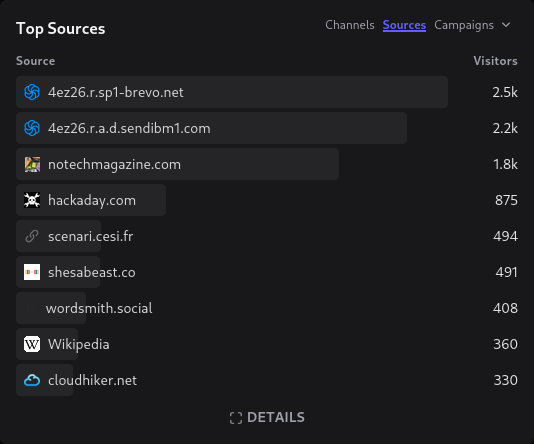
Here are Plausible’s traffic statistics between June 1st 2025 and December 1st 2025. Those dates are significant because in May Mastodon 4.4 was released which now includes the originating domain in the referrer statistics, allowing me to do this experiment with more confidence2.
Plausible shows different categories for traffic. The relevant ones are “Organic Social” and “Referral”:
Referral Traffic
Organic Social Traffic
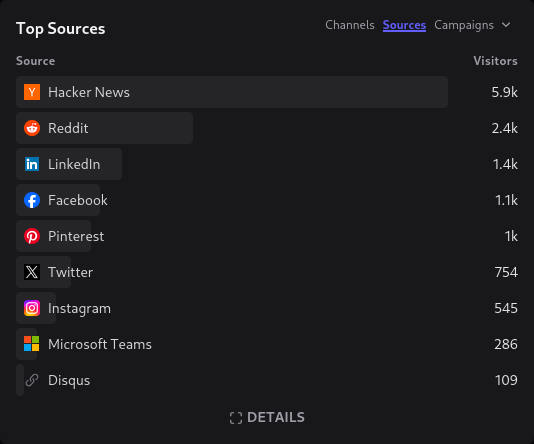
Now imagine these are your stats and you have to convince a boss, collaborator or associate to invest in the fediverse. How do you do that? Easy, you do your usual: “We should get on Mastodon! It’s very simple, your account is part of a kerflunk, and each kerflunk can…”.
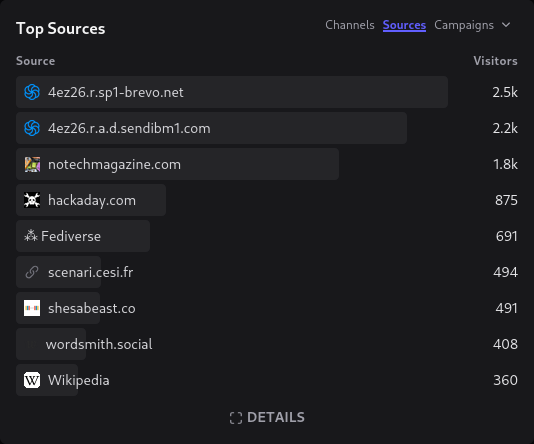
However, what if the traffic statistics look like this?
Referral Traffic (Aggregated)
Organic Social Traffic (Aggregated)
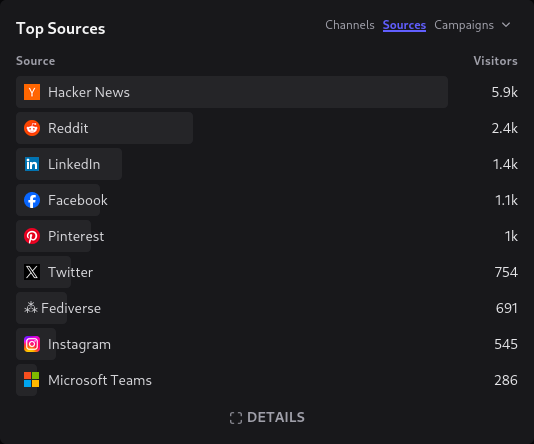
Then suddenly your conversation can be, “We should try this Fediverse thing; it is bringing in more traffic than Instagram!”
The above numbers are based on real data, differently presented. I had to put in a bit of effort to manually aggregate all the traffic from domains belonging to fediverse instances across different softwares3. This might not be 100% accurate, but I am after ballpark figures and a general argument: When those actual visitors are not hidden under the 50+ domains that would normally be found on page infinity of the listing, but as a single aggregate entity in the top 10, suddenly this federated social network starts to count.
If the system can not speak for itself, people will not use it.
Now, again, some people might be happy with this current situation. They don’t want the marketers. They don’t want the influencers. They don’t want the popularity contests. However, your local public governmental body, your independent news outlet, your favorite indie blog all rely on those statistics, at least in part, to decide whether they spend their limited time and budget on one outlet over the other.
If the fediverse wants to compete with the likes of Facebook, it needs to compete on the terms by which organizations decide to invest in Facebook. That requires, among others, for federated networks to become visible where bean counters count beans. People and organizations invest in Facebook to get their messages seen. Traffic statistics are how people know whether this works or not. Visibility in aggregate metrics is a crucial component to this.
At the same time, having those statistics is necessary to help those that engage in struggles within their organizations over the question of allocating resources to one system over the next. A crucial aspect of that is that the systems argued for need to speak for themselves rather than rely on passionate advocates or the good intentions of an organization4. If an organization spends money on Facebook/Instagram ads, they can see a cause and effect between that expenditure and additional visibility from the expected source5. If that same organization spends money on the fediverse6, poof that effect is nowhere to be seen, even if it exists. How do you argue for that within your organization? At the end of the day, if the fediverse cannot compete on that front because it is literally not competing as an aggregate entity, the fediverse is out of the race to begin with.
Privacy and tracking are, obviously, concerns here. However, there is a lot of space between doing nothing and being Google Adsense when it comes to traffic measurement. This is a solveable issue. The key thing here is to come up with a way, such as referral headers, where all Fediverse software identifies itself as such. Not as individual instances7, not as individual software projects, but as an aggregate entity on the web that, literally, counts.
-
According to fedidb.org, on 5/12/2025 ↩︎
-
I was also inspired by Terence Eden’s blog post on the fediverse becoming measurable. ↩︎
-
Plausible lets you search the list of domains. So I searched for “Masto” “Mst” “Pixelfed” “.social” “lemmy” and “piefed”. Then I added everything up. I also put way too much effort in editing the Plausible page source to make those screenshots. ↩︎
-
I base this on conversations I’ve had with different outlets and cultural practitioners active in shifting institutions away from commercial social media to the fediverse. These are usually passionate individuals that argue for the fediverse. However, people switch roles, or early enthousiasm wanes. Then, the next group of people are left to wonder: why are we spending resources on this again? ↩︎
-
At least, that is what one hopes happens. ↩︎
-
Spending money on the fediverse might, for instance entail, allocating staff hours to engage with it, or by spending money to host and operate an instance, or paying for a hosted instance. ↩︎
-
This is the current state of things since Mastodon 4.4, allowing me to pursue this thought experiment. However, this only surfaces the largest instances, rather than the ecosystem as a whole. ↩︎